How Many Times Have You Scanned Today?
Picture a typical morning: You walk out of your apartment, pull out your phone, and scan a QR code to unlock a shared bike. At the coffee shop, you scan a code to pay for your latte. Entering your office building, you present a dynamic access code at the turnstile. Finally, arriving at your desk, you scan the screen to securely log in to your desktop workplace apps. It's not even 9 AM, and you've already had at least four deep interactions with QR codes.
Invented in 1994 in a Japanese automotive parts lab strictly for industrial tracking, the QR Code has evolved to infiltrate the daily routines of billions. It is no longer a cold, industrial symbol, but the most efficient "portal" connecting the physical and digital worlds. Here are the 10 core scenarios where QR codes are currently reshaping our lives.
1. Mobile Payments
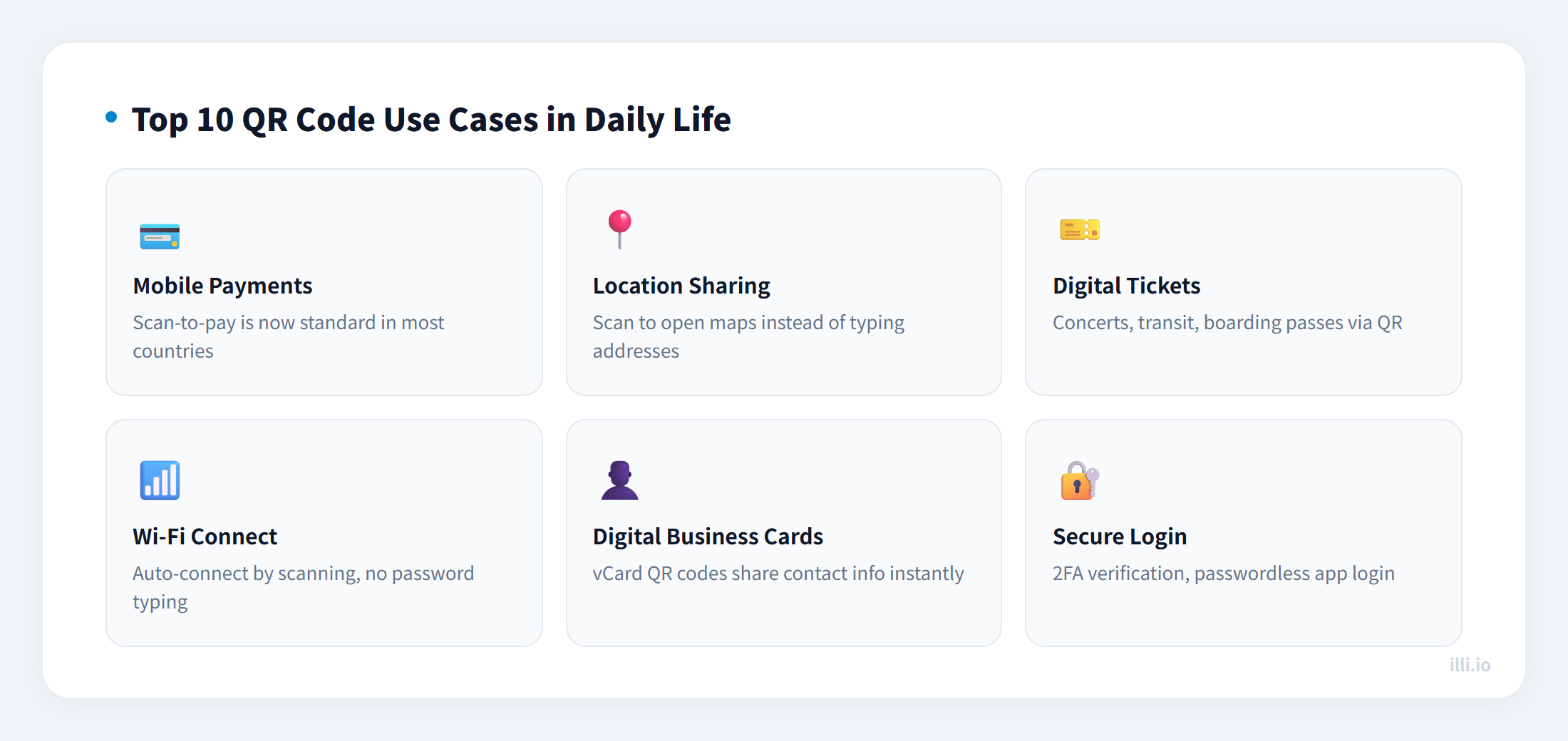
This is where most people feel its impact the most. From Apple Pay and Google Pay to Alipay and WeChat Pay, scan-to-pay has completely revolutionized retail. Whether you scan a merchant's printed QR code on the counter or present your own personal payment code to a scanner, funds transfer seamlessly in hundreds of milliseconds.
Tech Tip: Your personal "Payment Code" is actually dynamic, refreshing every minute. This relies on a one-time token mechanism designed specifically to prevent malicious screenshot theft.
2. Direct URL and Info Redirection
Condensing long, messy web URLs into a single QR matrix is its most classic use case. Scanning a movie poster on the subway, the back of product packaging, or a business card handed to you skips the tedious typing process entirely and drops you right into the specific promotional page or app download link.
3. Electronic Ticketing and Boarding Passes
When was the last time you printed a physical boarding pass or concert ticket? Today's digital credentials mostly live as QR codes safely tucked inside your phone's digital Wallet. A quick scan by the inspector's device instantly verifies your identity and grants access.
Tech Tip: High-security QR tickets often embed timestamped cryptographic digital signatures. Even without internet access, local scanning equipment can quickly verify their authenticity using asymmetric encryption algorithms.
4. Contactless Restaurant Ordering
The pandemic dramatically accelerated this trend. Now, upon sitting down at a restaurant, the first instinct is to scan the unique QR code affixed to the table. It doesn't just pull up an interactive digital menu with photos; it automatically binds your session to your table number, streamlining ordering, payment, and service requests into one seamless flow.
5. Social Networking and Contact Exchange
"Let me scan your code" has become standard ice-breaking behavior. Platforms like LinkedIn, WhatsApp, and digital business card managers use QR codes to perfectly replace clunky ID searches. Beyond basic links, vCard-formatted QR codes can be parsed instantly, automatically populating your phone's address book with names, emails, and job titles with a single tap.
6. The Lifeline of Logistics and Delivery
Every shipping label features unique barcodes and QR codes—the "passport" of a package navigating an immense logistics network. From warehouse sorting to transit scanning and finally the delivery locker, every scan updates the real-time tracking map you watch obsessively on your phone.
7. Secure Login and Authentication
Typing long, complex passwords and waiting for SMS verification codes on a PC is frustrating. Scan-to-login solves this elegantly. A web app generates a temporary QR code embedded with a session token; you scan it using your already-authenticated mobile app. The server binds the identities instantly and grants you access to the desktop version without a single keystroke.
8. Instant Wi-Fi Connection
Spelling out Password is: Abc123!@# to visiting friends is a universally painful experience. By encoding the Wi-Fi SSID, encryption type, and complex password into a standardized QR layout, guests can simply point their native smartphone cameras at it to join the network instantly.
9. Supply Chain Traceability and Anti-Counterfeiting
For high-value consumer goods (like cosmetics, luxury items, or imported seafood) and pharmaceuticals, QR codes are vital for supply chain transparency. A quick scan shows consumers origin data, harvest dates, and cold-chain temperature logs. Coupled with "scratch-to-scan" anti-counterfeiting mechanics, it effectively prevents the resale of fake products.
10. The Keys to the Sharing Economy
Bike-sharing, power bank rentals, and even shared massage chairs... without QR codes, this entire business model of fractional leasing would collapse. Here, the QR code acts as a decentralized digital key. You scan a physical device's ID, your app sends an unlock request to the cloud, and the backend issues an IoT command to release the physical lock—all functioning like clockwork.
Epilogue: The Borders are Still Expanding
While these 10 scenarios encapsulate a massive shift, the evolution of QR codes hasn't stopped. From serving as digital health passports to facilitating offline CBDC (Central Bank Digital Currency) transactions, or acting as spatial anchors in Augmented Reality (AR), this simple matrix of black and white squares continues to push the boundaries of our digital existence.