Why Barcode Formats Matter
Barcodes may all look like a series of black-and-white stripes, but there are actually multiple encoding standards with significant differences in data types, character capacity, and industry applications. Choosing the wrong format doesn't just cause scanning failures — it can get your products rejected by retailers or held up at customs.
Major Barcode Formats Overview
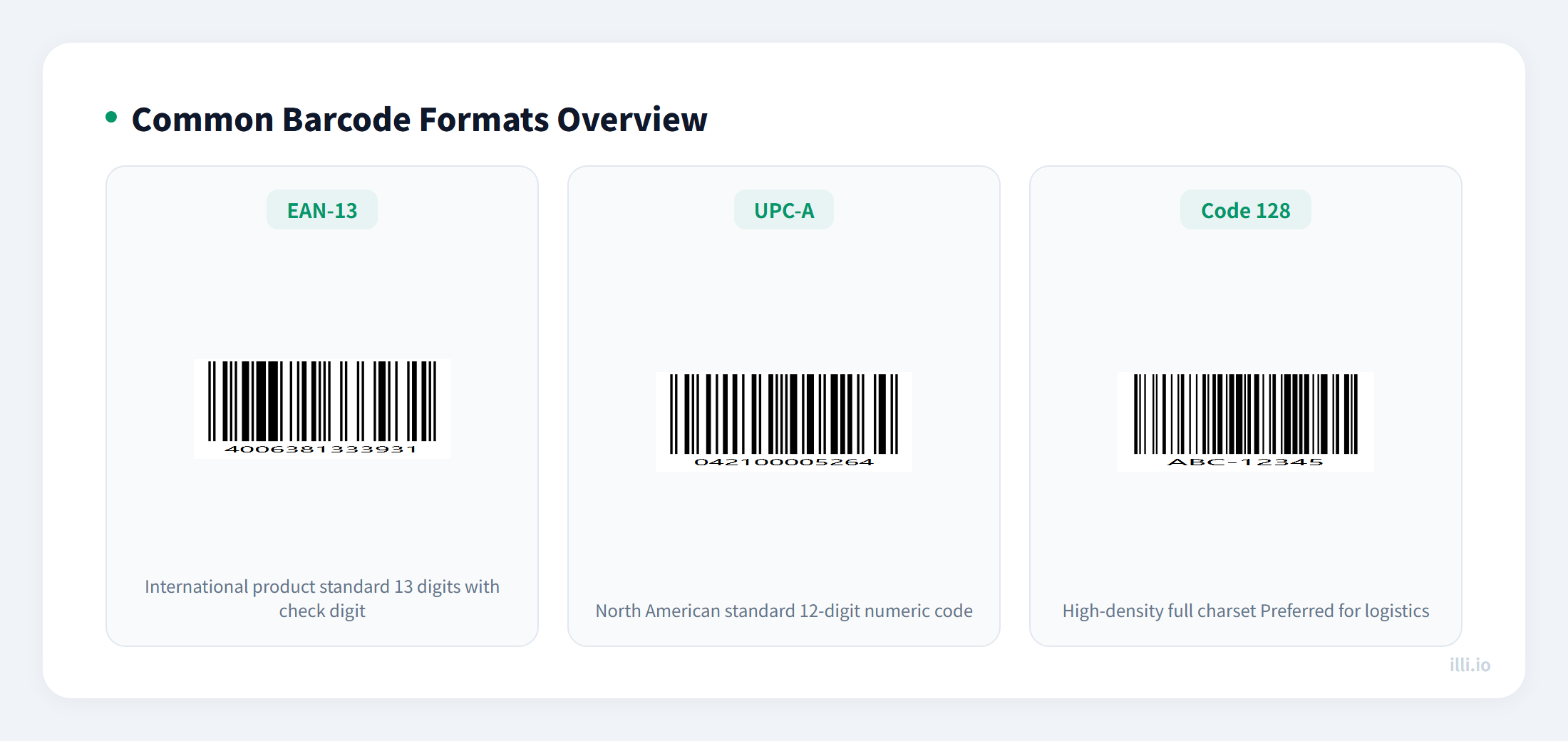
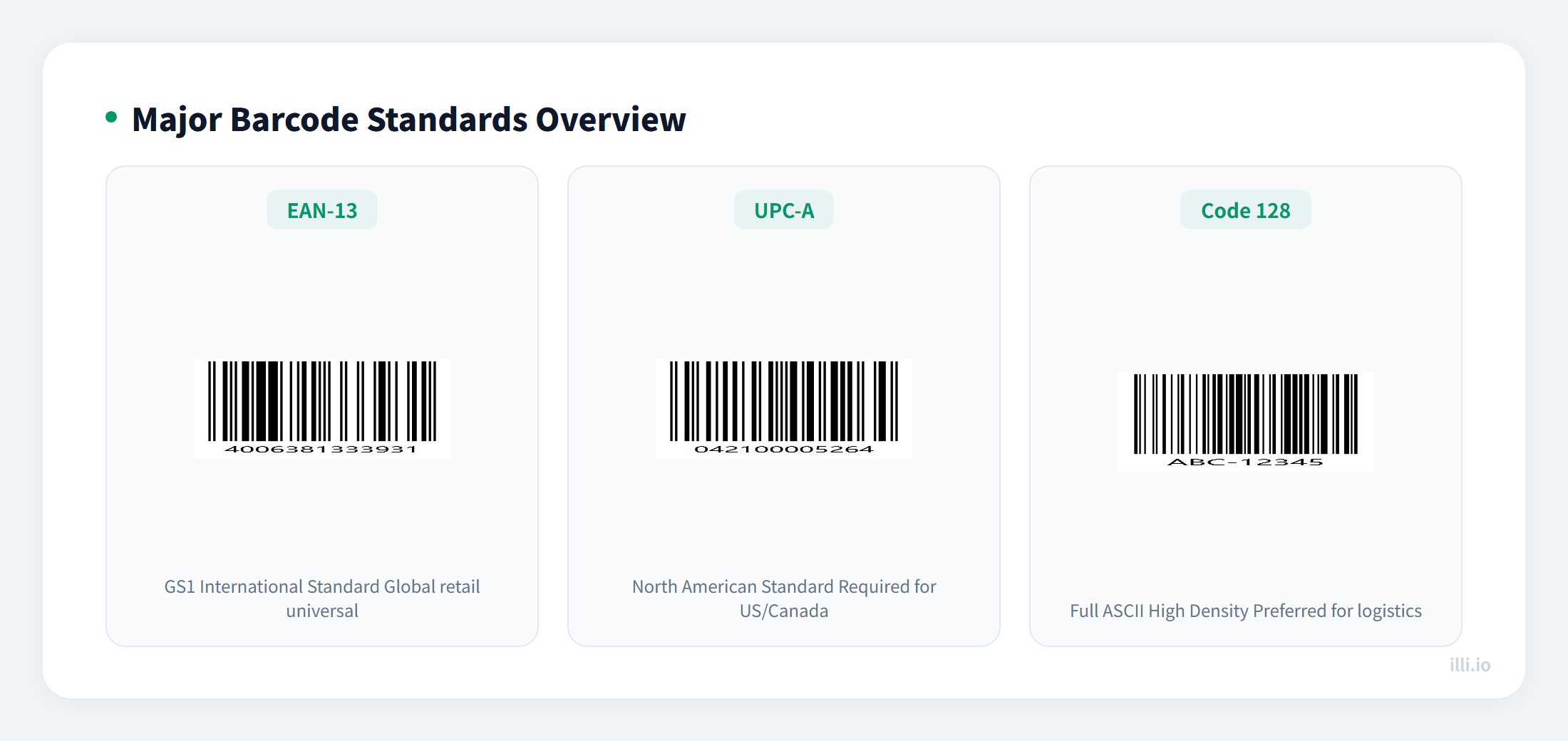
EAN-13 (International Product Barcode)
Managed by the GS1 organization, EAN-13 is a 13-digit numeric code. The first 3 digits are a country/region code (e.g., 690-699 for China), followed by manufacturer code, product code, and a check digit. Retail systems in over 150 countries rely on it as foundational infrastructure.
- Use cases: Supermarket products, pharmaceuticals, books (ISBN converts to EAN-13)
- Limitation: Digits only, fixed 13-digit length
UPC-A (North American Product Barcode)
The standard retail barcode for North America, 12 digits. Required for products entering US or Canadian retail channels.
- Use cases: US/Canada retail products
- Relation to EAN-13: UPC-A is a subset of EAN-13 (add a leading 0 to get EAN-13)
Code 128 (High-Density Full-Character Barcode)
Supports all 128 ASCII characters (letters, digits, special symbols) with extremely high information density. The preferred format for warehouse management, shipping labels, and asset tracking.
- Three subsets: 128A (uppercase + control), 128B (upper + lowercase), 128C (numeric pairs, highest density)
- Use cases: Shipping labels, factory tracking, medical specimen labels
- Advantage: Variable length, automatic subset switching for density optimization
Code 39
An older standard supporting uppercase letters, digits, and a few special characters. Lower density but simple to implement, still used in defense and legacy systems.
ITF-14 (Outer Case Barcode)
Designed specifically for logistics outer packaging, 14-digit numeric encoding. Uses interleaved 2-of-5 encoding, suitable for direct printing on corrugated cardboard boxes.
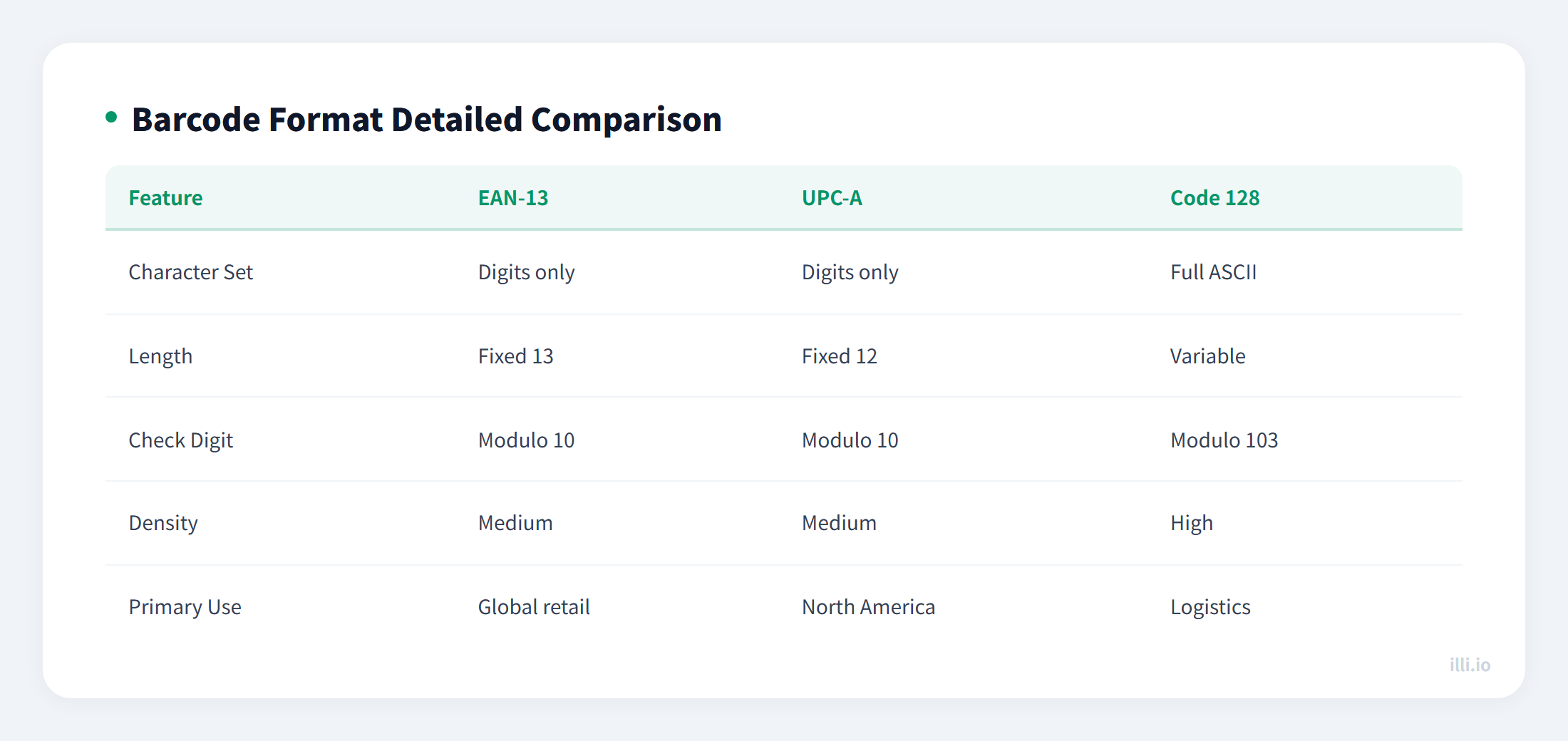
Format Comparison Table
How to Choose the Right Barcode Format
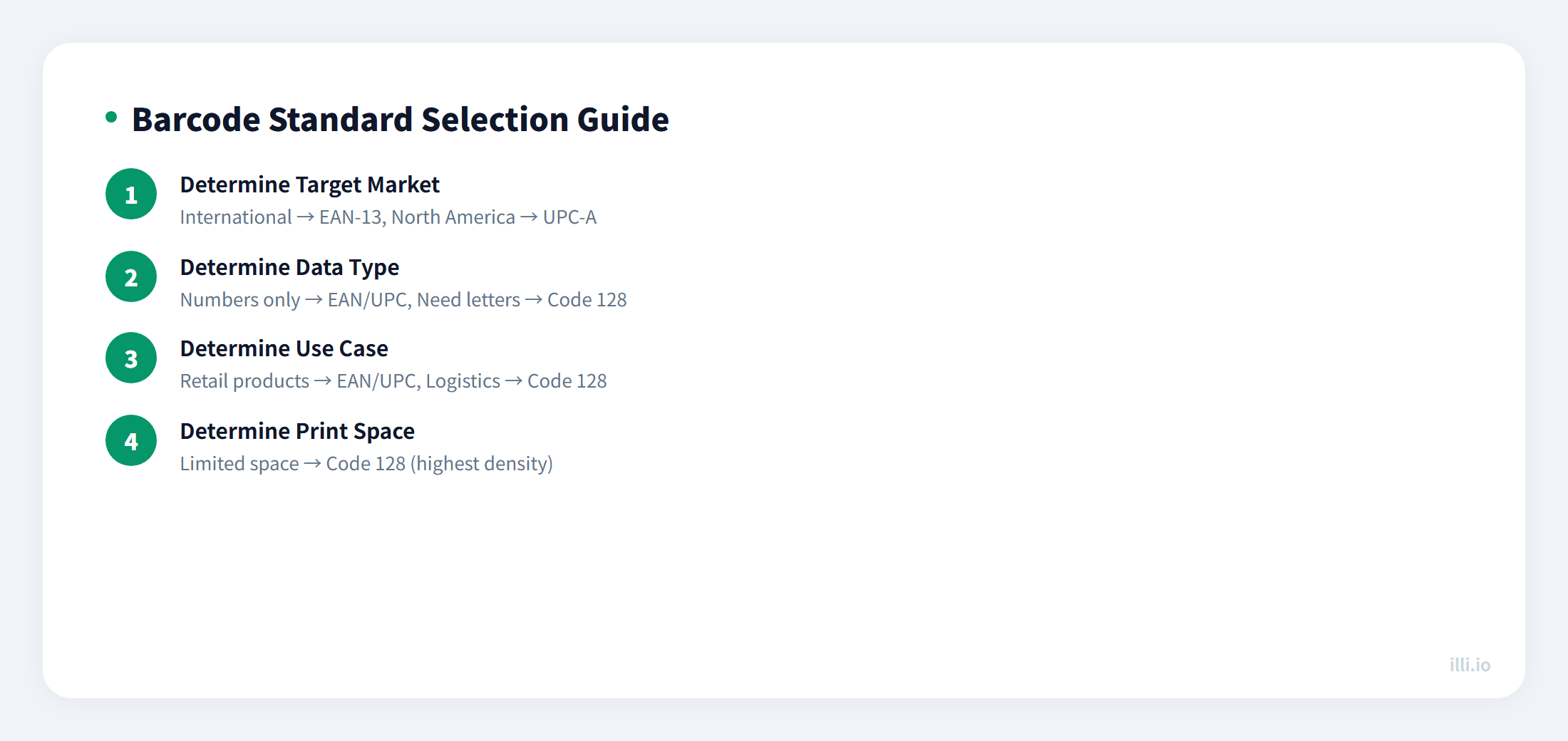
By Target Market
- International markets: EAN-13 is the only choice
- North America only: UPC-A (EAN-13 also works)
- Internal systems: Code 128 (flexible, high density)
By Data Type
- Digits only (product IDs): EAN-13 or UPC-A
- Letters or special characters: Code 128
- Logistics outer case marking: ITF-14
GS1 Registration Requirements
To sell products through retail channels, you need to apply for a manufacturer code from your country's GS1 member organization. Without a legitimate GS1 prefix, generated barcodes will not be recognized by standard retail systems.
Practical Tips
- Quiet Zone: At least 10x the narrowest bar width of blank space on each side
- Print Resolution: At least 300dpi to ensure crisp bar edges
- Vector Format: Use SVG for distortion-free output at any size
- Test Scanning: Always test with target scanning devices before final printing
Advanced Formats: Data Matrix and PDF417
While this article focuses on 1D barcodes, you may encounter two "2D barcode" formats in real-world selection:
Data Matrix
A square-shaped 2D code commonly found on electronic components, pharmaceutical packaging, and aerospace parts. Its key advantage is encoding large amounts of data in extremely small areas (as small as 2×2mm), making it ideal for Direct Part Marking (DPM) on micro-components.
- Data capacity: Up to 2,335 alphanumeric characters
- Error correction: Built-in Reed-Solomon correction, readable even with 30% damage
- Industry standards: FDA drug serialization (DSCSA), automotive part traceability (AIAG)
PDF417
A stacked 2D barcode consisting of multiple 1D barcode rows stacked vertically. Most commonly seen on ID documents and boarding passes.
- Data capacity: Up to 1,850 alphanumeric characters
- Features: Can encode text, numbers, and byte data; supports linking multiple PDF417 codes for transmitting very large datasets
- Applications: US driver's license backs, IATA boarding passes (BCBP)
Format Selection Decision Tree
When faced with multiple format options, use this logic for quick decisions:
- Will the product enter retail channels? → Yes: EAN-13 (international) or UPC-A (North America)
- Need to encode letters or special characters? → Yes: Code 128
- For logistics outer cases? → Yes: ITF-14
- Need to encode in very small areas? → Yes: Data Matrix
- Need to encode large structured data? → Yes: PDF417 or QR Code
- Targeting consumer smartphone scanning? → Yes: QR Code
Remember: there's no "best" format — only the one that best fits your business scenario. Use the illi.io barcode generator to quickly test different format outputs.
Summary
Barcode standard selection depends on three core factors: target market, data type, and use case. Retail products use EAN-13/UPC-A, logistics use Code 128, outer case marking uses ITF-14. Use illi.io barcode generator to quickly create HD vector barcodes in all major formats.